

Analysis
Two paradoxes stand out in relation to gender and Brazil’s 2026 elections. First, while women are central as voters, they remain markedly underrepresented in political institutions. Second, despite persistent gender-based violence and gender inequalities in Brazil, progressive forces struggle to expand their appeal among women, while the (far) right experiences growing support among segments of this decisive group. This analysis explores the two paradoxes and offers reflections on potential implications of the upcoming elections for both gender equality in Brazil and EU–Brazil relations.

Elections in Brazil are only a few days away. The presidential race will likely go to a run-off, and opinion polls point to a tight contest between the left-wing incumbent, Lula da Silva, and Flávio Bolsonaro, the son of the former far-right president Jair Bolsonaro.
A gender gap has been observed in Brazil since 2018, when Jair Bolsonaro was elected president. Women, particularly the younger, were less likely than men to vote for him. This trend intensified in 2022, when women tended to reject Jair Bolsonaro and support Lula more than men. However, according to recent polls, this is less the case now, despite the fact that Flávio Bolsonaro represents the same ideological project as his father. Gender has been virtually absent as an issue. But both leading candidates have actively tried to attract more female voters.
Women are protagonists as voters, but remain underrepresented in political institutions
Women not only represent 53% of the electorate, but by now they also head more than half of Brazilian households. Compared to men, women have shown less interest in the present race and represent a bigger share of undecided voters.
In 2018, under the motto #EleNão, massive protests led by women were organised across Brazil in rejection of Jair Bolsonaro. In 2022, female support was one of the most relevant factors in Lula's victory in a very tight race against the far-right candidate. Women were generally hostile to Jair Bolsonaro's aggressive tone, the way he mishandled the Covid-19 pandemic and his efforts to loosen restrictions on gun ownership.
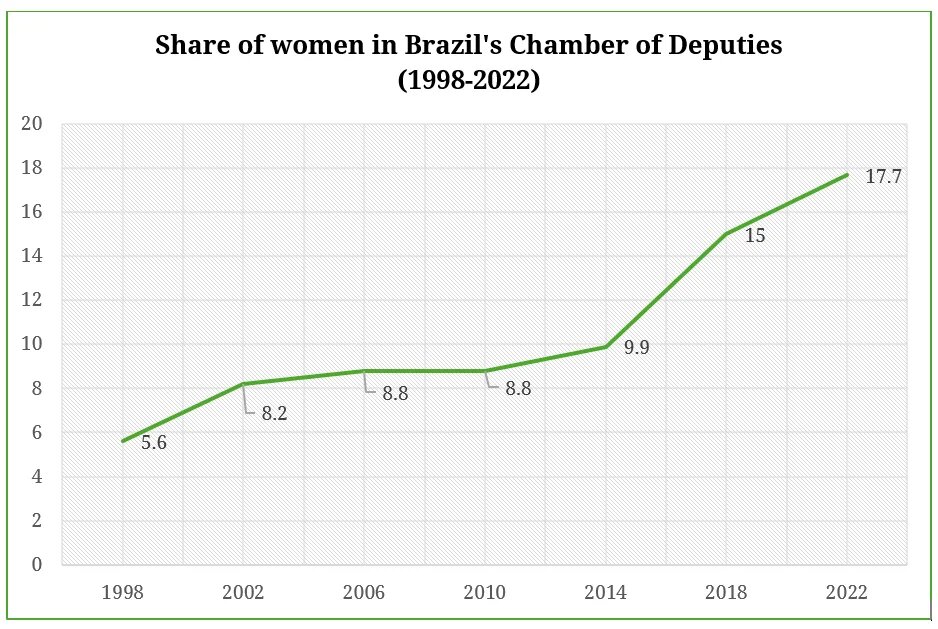
Despite their relevance as voters, women remain underrepresented at all institutional levels. Brazil performs weakly (139th) in the Inter-Parliamentary Union global ranking. Over time, progress has been extremely slow and stalled, as illustrated by the share of women in the Chamber of Deputies over time (see figure below). Women's representation reaches similar levels in the state legislative assemblies: it increased slightly from 15% in 2018 to 18% in 2022.
There are no gender quotas at the level of political institutions, only for legislative candidacies, according to which political parties are required to allocate a minimum of 30% and a maximum of 70% to each gender among their candidates for proportional elections. Nevertheless, after 30 years in place, this quota policy has been ineffective in changing women's access to institutions. Political parties have found ways to comply with formal requirements while circumventing the intended effects of substantive change. Strong structural barriers to women's election and sustained political participation remain in place. Although parties field more than 30% women candidates for proportional elections on average, this does not translate into a similar level of political representation, which stagnates at around half that share.
Women's under-representation is even more striking in the executive branch. In a country that has had only one female president to date, just two (7% of the total) of the 38 female candidates for state governor (17% of the total) were elected in 2022. In 2026, 32 female candidates are running for governor, but they are less competitive than in the previous election. Those with higher chances of winning were already present in state institutions. For the first time since re-democratisation, there is no woman running for the presidency or vice-presidency among the competitive candidacies.
The battle for female voters
Both Lula and Flávio Bolsonaro have made clear efforts to gain support from female voters. They have broadcasted dedicated campaign advertisements targeting women. In their manifestos, both have mentioned women (Lula 27 times and Flávio 24) and included specific policies tailored to them. Spouses, female family members and female partisan leaders have been engaged in their campaigns. Both Lula's and Flávio Bolsonaro's advertisements have focused on addressing femicides and protecting women.
Lula's programme centred on the government’s achievements: amplification of state structures for protection against gender-based violence and the passing of the equal pay law, among others. The programme also goes beyond protection from gender-based violence and addresses care, the fight against discrimination and sexism, and the promotion of reproductive health and rights. Lula's advertisement recalled the sexist behaviours of Jair Bolsonaro, in an attempt to remobilise the fear that his aggressive tone generated among women.
But Flávio Bolsonaro contrasts with his father in that he tries to appear more 'moderate' and considerate of women. Aware of the strategic importance of this segment, Flávio's manifesto dedicates a whole section to targeted policies. Women are primarily framed as mothers and family carers. Supporting and protecting them is framed as a means to promote the family, a central construct for the far right. His programme focuses on two areas: punishing aggressors as a way to ensure women's safety, and making women's lives ‘easier’, mainly through the expansion of digital services and AI use. However, his overtly optimistic and uncritical approach to the reliance on AI across all areas of life (including support in cases of gender-based violence) is very concerning, as it disregards the increasing and disproportionate risks posed by digital technologies to women.
While the left struggles to attract female voters, the (far) right gains ground
Recent polls show a narrowing difference between men’s and women's voting preferences in 2026, compared with previous elections. Flávio Bolsonaro has found more openness among women compared with his father, while Lula struggles to expand his appeal.
This can be partly explained by growing fatigue with Workers' Party governments: this is Lula's seventh campaign and third term, and both remain anchored in long-standing policies such as Bolsa Família and Minha Casa Minha Vida, with little innovation. While these policies have contributed to income redistribution and inclusion, and social assistance is now widely seen as a consolidated right, the government's positive macroeconomic indicators have not fully translated into improvements in citizens' daily lives – and women experience this gap most directly, through struggling schools, insecurity, falling purchasing power and inefficient healthcare. Brazilians are facing an affordability crisis, record household debt, rising feelings of insecurity (especially among women) and corruption scandals involving the Supreme Court that have dominated the electoral scene.
However, cultural values also matter a great deal, and conservative positions, particularly on gender issues, remain prevalent in Brazil. As a deeply religious country, abortion rights, for instance, remain a major taboo. No candidate dares touch this topic. Even among women, the view that abortion should remain strictly restrictive prevails. More than 60% of them agree with the statement 'a woman who has an abortion should go to jail'.
Women are also heterogeneous, and their positions are constantly evolving and interacting with multiple social, cultural and economic factors. As evangelical religion gains ground among Brazilians, belonging to this religion increasingly shapes political behaviour too. Since 2018, evangelicals have largely supported the far-right candidate, by an average of 70%, and rejected the Workers' Party. Far-right leaders have been successful in mobilising moral issues that touch on a core value: family.
Jair Bolsonaro's wife, Michelle, is a central figure and was well-positioned to run for the presidency before Flávio's nomination. An active member of the Evangelical Church, she is the second most popular right-wing figure in the country, only behind her husband, and has increasingly mobilised female voters and candidates nationwide. Since she took over leadership of the Liberal Party's (PL) women's wing, female affiliations have notably risen, as has the number of female candidates elected in the 2024 municipal elections.
Michelle's rise illustrates a broader trend of increasingly visible and competitive female politicians strategically launched by conservative and far-right parties. The PL is fielding strong Senate candidates in the Federal District (where Michelle is polling first) and Santa Catarina.
Research shows the share of right-wing congresswomen has grown over the past decade, and since 2014 has outpaced the share of left-wing female deputies. This year, the PL caucus is projected to be strong in both legislative chambers. In addition to party politics, politically motivated influencers (including female ones) have found fertile ground to disseminate anti-feminist and anti-gender campaigns online.
Evangelical women, especially Black and poorer groups, will be key segments to watch. They are likely to face conflicting interests when deciding their vote and have taken longer to make that decision. At the same time, as they benefit from Lula's redistribution policies and are directly affected by the cost-of-living crisis, they also care significantly about moral and cultural issues, especially regarding the stereotype of 'radical feminism' and topics affecting the family.
Implications for gender equality in Brazil
Jair Bolsonaro's government offers a preview of what a Flávio Bolsonaro presidency could mean for gender equality in Brazil. Brazil remains a conservative, deeply religious and highly violent country, particularly for women and gender minorities. A far-right victory poses a real risk of dismantling both mobilisation and policies built to counter these harmful trends.
A Bolsonaro-style government would likely accelerate the normalisation of misogyny and gender-based violence, with a weaker focus on measures to prevent gender-based violence, stronger promotion of traditional gender norms and failing protection of minorities' rights, all of which at a time when digital platforms remain largely unregulated and anti-gender content and influencers are already gaining ground online.
Flávio's own uncritical embrace of AI as a solution to social problems, including gender-based violence, is telling in this regard: it demonstrates limited awareness of the risks digital technologies pose to women, and could create fertile ground for anti-feminist propaganda and the further rise of anti-gender influencers, rather than a serious response to the structural drivers of gender-based violence.
Implications for EU–Brazil relations
The implications of the elections extend beyond Brazil's borders. The main consequence of a far-right win would be closer political alignment with the Trump administration in the US, including on the anti-gender agenda that has increasingly shaped transnational far-right politics and been weaponised to foster democratic instability. This would likely make European cooperation with the Brazilian government harder on issues of democracy, human rights and gender equality, as Brasilia could resist engagement in these areas and deprioritise them in trade and diplomatic relations.
In this scenario, the EU's role in supporting Brazilian civil society organisations working for democracy, gender equality and human rights could become even more critical. The EU might also need to find alternative channels for cooperation, working directly with progressive entities at the sub-national level in cases where alignment with universal values persists, even if the federal government moves away from them as a result of a drastic political shift.
The views and opinions in this article do not necessarily reflect those of the Heinrich-Böll-Stiftung European Union | Global Dialogue.

